Pre-Wedding and Wedding Photos in Tokyo: gardens, hotel interiors and the city at night
The pre-wedding session — a couple in dress and suit, no ceremony, no guests, one day of photographs — is a mainstream reason to fly to Tokyo, and this guide treats it as the main subject rather than a warm-up. Japan invented the domestic version of it, so everything the day needs is here: dress hire, dressers who will travel, hair and make-up at seven in the morning. What catches visitors out is that half the beautiful places in Tokyo require written permission to shoot in formal dress, and the other half require you to be standing there before the city wakes up.
Real shots from Tokyo
Classical gardens, and the permission that decides everything
Two gardens carry most of these sessions. Rikugien is a strolling garden around a pond, with a low hill you climb in three minutes for the view back across the water and maples that turn in late November; it is a short walk from Komagome on the Yamanote line. Hama-rikyu sits where the Sumida meets the bay: a tidal saltwater pond with a teahouse on an island, old pines, and the Shiodome towers directly behind them — the one frame that puts an Edo garden and a glass skyline in the same picture.
The rules matter more than the frames. A posed session in bridal wear in a Tokyo garden normally means an application, filed in advance with the garden's office, not something you turn up and do. Gardens set their own terms and they differ: some refuse bridal wear outright, some treat kimono differently from a white dress, some allow it only on certain days or in certain parts of the grounds, most cap the party size, and equipment rules commonly ban stands and ladders.
So the sequence is: choose the garden, ask the garden, then book the day. A photographer who works here will know which garden currently says yes and how far ahead to apply. If the answer is no, the fallback is a public park, a hotel with its own garden or a private venue. Meiji Jingu is the shrine everyone suggests: its grounds are a working sanctuary with its own rules on arranged shoots, so ask rather than assume.
Tokyo Station, Marunouchi and the Gaien ginkgo
The Marunouchi face of Tokyo Station is red brick, restored to its original domes and floodlit after dark. The plaza in front is public and big enough to work in, and the axis down Gyoko-dori towards the palace gives the symmetrical frame. Timing decides everything: on a weekday morning this plaza is a commuter crossing, and early on a Sunday it is nearly empty.
The elevated view is from the roof terrace of the KITTE building across the road, open to the public with its own hours and its own rules on photography — check that it is open before you build a morning around it. Behind it, Marunouchi Naka-dori is a tree-lined avenue with arcades on both sides, lit through the winter months on dates that change each year; the pavement is public, the arcades belong to the buildings.
West of there, four rows of ginkgo run a few hundred metres from Aoyama-dori towards the Meiji Memorial Picture Gallery, and for about two weeks in the second half of November they turn the street into a yellow tunnel. It is a public street with traffic, packed at weekends in the peak, so go on a weekday at first light — and check current access, because the Gaien district is being redeveloped.
Water and neon: the bay and the crossing
Odaiba is where Tokyo photographs like a waterfront rather than a warren. The promenade in its seaside park looks back across the water at the Rainbow Bridge and the towers behind it, and the twenty minutes of blue hour after sunset are the entire reason to be there — in winter they arrive early, which for once is an advantage. The Yurikamome from Shimbashi crosses the bridge on the way. Take the wind seriously: a veil is unmanageable out there.
The Shibuya Scramble is the loud version of the same idea and it needs a light touch. It is a working crossing: you get one cycle of the lights, you do not set up in the middle, and anything that looks like a production draws attention from the ward and the police: a couple and one photographer moving with the crowd is fine, a crew with lights is not. The Hachiko side and the walkways above are the vantage points; the paid observation decks set their own rules on professional shoots.
Rain: lobbies, arcades and the indoor half
Tokyo rains properly from June to the middle of July, and typhoon days land in September and October. An indoor plan is not a consolation prize here, it is half the portfolio. A hotel lobby is the obvious answer, with one condition: a hotel is private property, so the lobby you use is the one you are booked into or one that has agreed in advance. The same goes for station concourses, department stores and office atriums. The public version is the covered shopping street: older arcades with glass roofs, the Ginza colonnades, underground concourses with tiled walls, dry and lit.
What clients say about this kind of shoot
Marvin is so nice ! and also knows good spots where to take photos ✨✨✨ I RECOMMEND
— Btihal on Marvin T.
A lovely experience. Marvin knew all the good spots and led the way. No thinking necessary on my part, which I loved. A pleasure to work with.
— Siobhan on Marvin T.
Marvin is FANTASTIC! He captured amazing photos of us and they were exactly what we were wanting from the session. Marvin knows all the best spots and ensures you have the best experience. Highly recommend Marvin’s photography services.
— Sara on Marvin T.
We had a great time during our photoshoot with Marvin! He had a whole plan for where to take the best photos in Shinjuku and gave us clear instructions on how to pose to get the best shot!
— Soren on Marvin T.
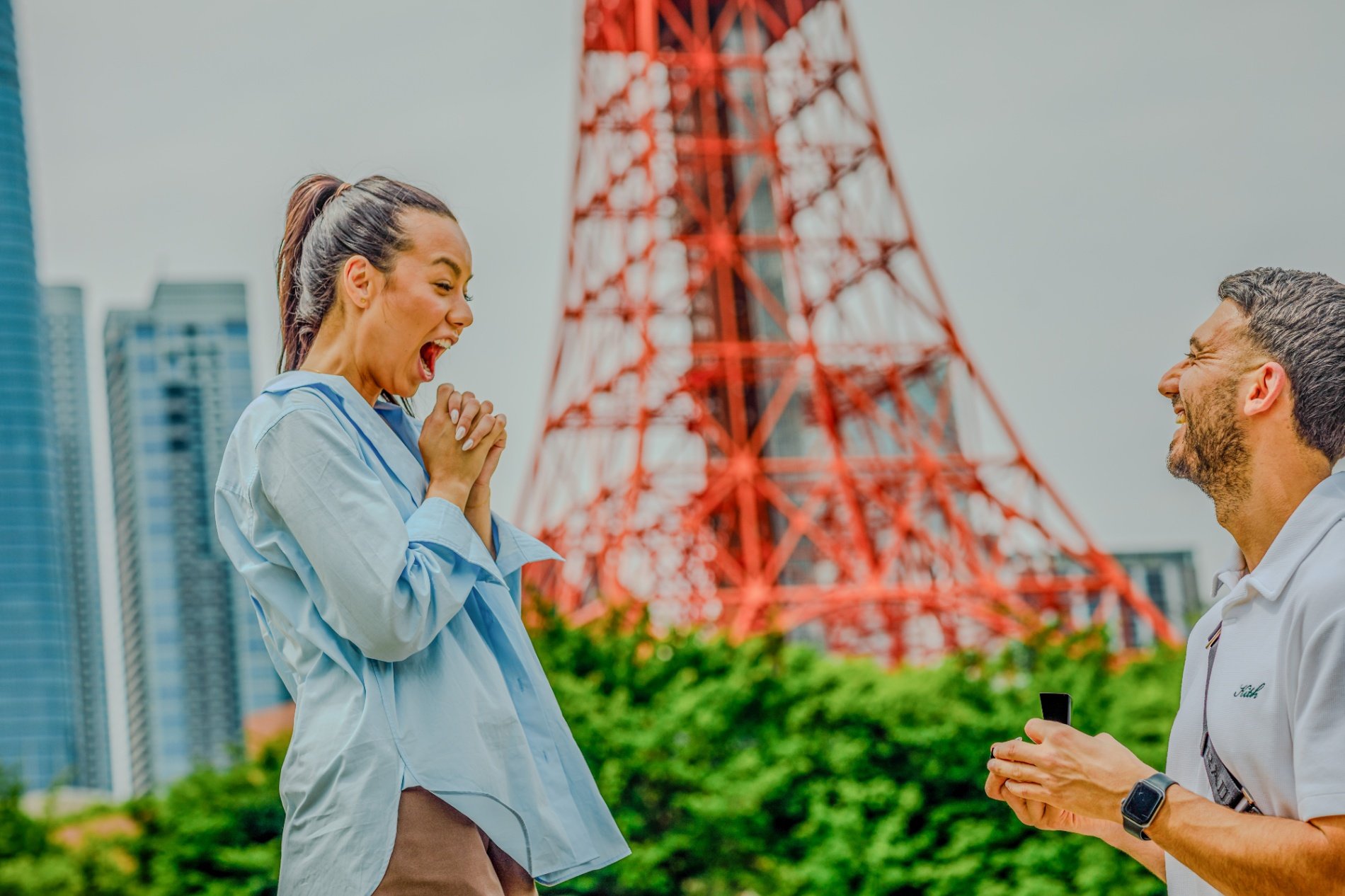
Marvin was the best. Very professional while also being very friendly! I wanted a surprise proposal photoshoot and everything went according to plan. He voluteered to hold our bags while we walked around taking photos. The preview shots look amazing. I can't wait to see the finished photos
— Luis on Marvin T.
We 100% recommend Marvin. He was very professional, put us at ease, and suggested plenty of poses and locations. The photos are magnificent—don’t miss the chance to book a shoot with him.
— Anais on Marvin T.
Dressing, changing and what a pavement does to a train
Most couples dress at the hotel, have hair and make-up done there first thing, and travel to the first location with a coat over the dress. Take a taxi rather than a train if the dress is large: a train is fine at six in the morning and a bad idea at half past eight. A dresser is not optional for kimono — the kitsuke takes time and cannot be improvised — and is booked through the rental shop.
A second outfit means a changing point, decided in advance: a hotel room held for the day or a rented dressing room near the location. And a white train on Tokyo asphalt is grey within ten minutes, so keep the hem off the ground early, give somebody the job of carrying it, and accept that the last location of the day is where the dress takes the dirt.
The shape of a two-location day
A day that works looks like this: hair and make-up early, first location at sunrise while the garden or the plaza is empty, a taxi across town mid-morning, second location before the streets fill. Then a long break — and it needs to be long, because formal dress on a Tokyo summer afternoon is punishing — and a last window at blue hour on the bay or in Marunouchi.
Budget the traffic honestly: Marunouchi to Rikugien is around twenty-five minutes by taxi at six in the morning and considerably more at nine, and Gaien to Shibuya is ten. Two locations done properly is the realistic maximum with one outfit, three with a change is a long day, and four is a list somebody wrote without walking it.
Kamakura and Hakone for day two
Kamakura is under an hour from central Tokyo on the Yokosuka line: the great bronze Buddha at Kotoku-in sitting in the open air, Hase-dera's terraces looking over the roofs to the sea, and the Enoden rattling between houses and beach. It is also a small town with a genuine crowd problem at its famous seaside level crossing, where the local rules are posted for a reason.
Hakone is the other direction, ninety minutes by limited express from Shinjuku, and it is where Fuji either appears or does not — best odds on clear winter mornings from November to February. The Hakone Shrine's torii standing in Lake Ashi has a marked queue and a posted limit on how long each group gets at the front, and those rules have been tightened before, so read the sign on the day.
What an actual wedding day changes
If this is a wedding rather than a pre-wedding, the venue decides, not you. Hotels and wedding halls in Tokyo work with their own photographers; an outside one is either refused or admitted against a bring-in charge, and that rule lives in the contract you sign. Shrines set their own rules about who may photograph a ceremony and from where, and the answer can be nobody from outside. Guests add their own arithmetic too: hotels near the venue, taxis pre-booked, a schedule that runs to the venue's clock. Which is why so many couples end up doing both — the ceremony where the family wants it, and the photographs on a separate morning in a place chosen for the camera.
Planning pre-wedding photos in Tokyo
Work backwards from permission. Fix the dates, ask the gardens or venues whether a dress is allowed and how far ahead they need the application, then book the photographer, then the dress, the dresser and the hotel room. That order costs nothing and saves the day.
On seasons: late March into early April for blossom, with the dates moving by up to two weeks; the last fortnight of November for the ginkgo; June to mid-July for rain; August for heat that formal dress does not survive. The underrated season is winter: clear air, clean light, blue hour before five, everything available.
A photographer who shoots Tokyo weekly knows which garden is saying yes this season, which plaza is empty on a Sunday and how long the taxi really takes. Start with the destination page for Tokyo, read what an engagement session or a wedding shoot covers, and book a photographer online.
Want professional photos in Tokyo?
Browse portfolios, compare packages, and book a verified local photographer in minutes.