Planning Wedding Photos in Kyoto: shrine ceremonies, venues and permissions
A wedding in Kyoto is not short of backdrops. It is short of permissions. Every frame you might want belongs to somebody — a shrine, a hotel, a garden, a restaurant — and each of them decides separately whether a camera may be in the room, who may hold it and where that person may stand. Those decisions are made before your date and written into contracts, and almost none of them can be changed on the day.
The shinzen shiki, from the camera's side
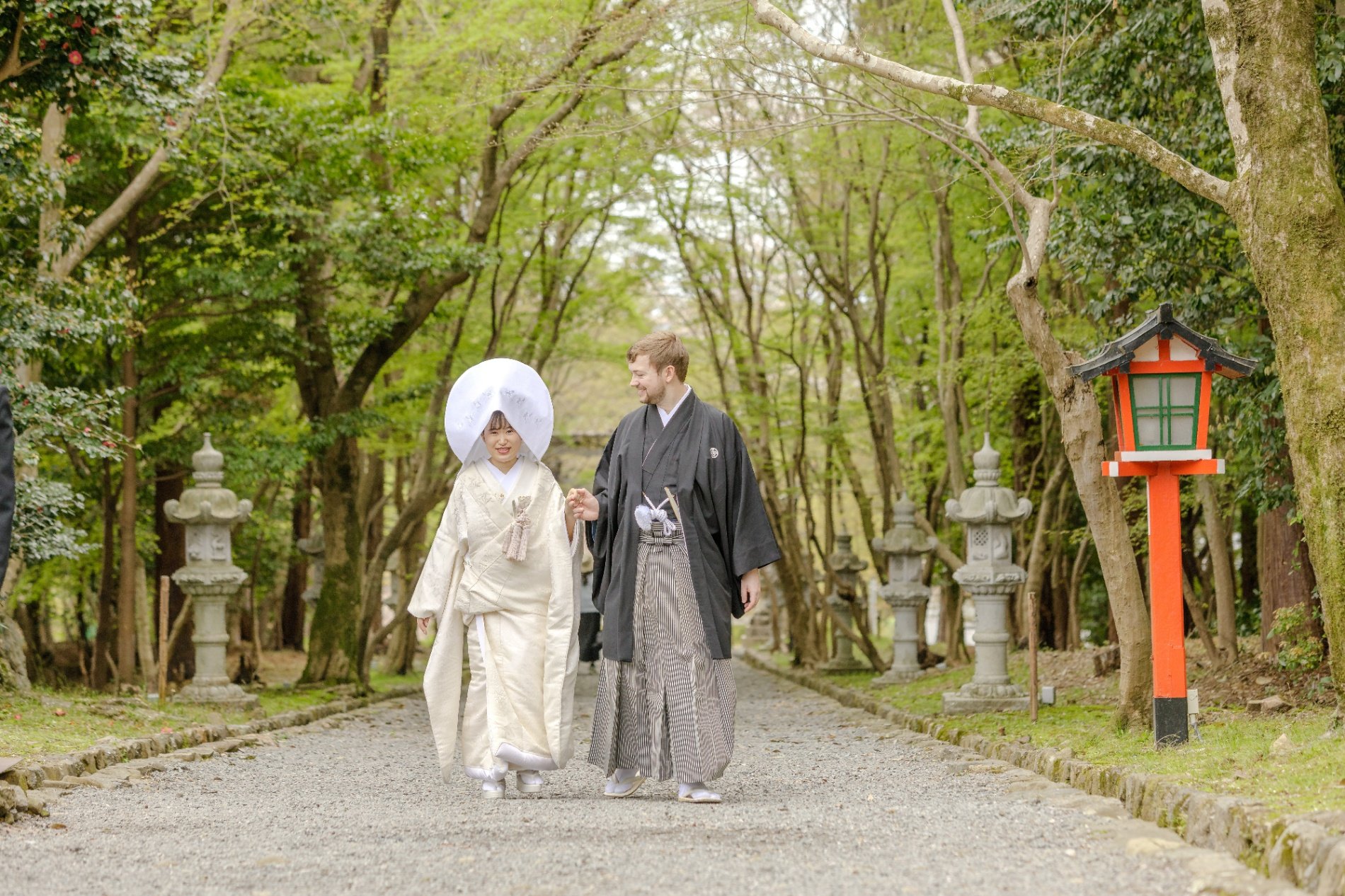
A Shinto wedding takes place in a shrine's ceremony hall, conducted by a priest, with the two families facing each other rather than a room full of guests. Purification comes first, then the priest's address to the deity, the three-cup sake exchange, rings in most modern versions, and an offering of a sakaki branch. The bride wears a white shiromuku or a coloured uchikake with a hood or headdress, the groom montsuki haori hakama. It is formal, quiet and short — usually well under an hour.
The part that photographs best is often outdoors and lasts minutes: at many shrines the party walks from the dressing room to the hall in procession, the bride under a red parasol held behind her. Whether it happens depends on the shrine and the package — at some it is standard, at others not offered. Ask specifically, because it is the difference between pictures of a building and pictures of a wedding.
Worth knowing early: a ceremony in Japan, at a shrine or in a chapel, is not a legal marriage. That happens when the notification is filed and accepted at a municipal office, which for foreign nationals means embassy documents and translations. Many couples handle the legal step at home and come here for the day itself.
Who is allowed to photograph inside the hall
This is the question that shapes everything else, and each shrine answers it separately — not necessarily the way it answered last year. Some admit one outside photographer who works from a fixed position at the back and does not move. Some allow photographs before and after but not during. Some no longer admit an outside photographer into the sanctuary at all and supply their own. Some permit stills but not video, or restrict where the images may be published.
Shrines in Kyoto that hold Shinto weddings include Heian Jingu, Shimogamo, Kamigamo and Yasaka, and their terms are not each other's. Most visiting couples reach them through a planner or bridal agency that holds the arrangement with the shrine rather than by writing directly, and some shrines only host ceremonies booked through their own affiliated hall. Whether a shrine takes bookings from couples who are not local is also its own decision.
Put these questions in writing before you book anybody: may an outside photographer enter the hall, and where may they stand; may they photograph the procession; may they work in the grounds before and after, and for how long; is a second camera permitted. A yes on the phone is worth nothing in June.
Venues that come with their own photographer
Hotels and wedding venues in Japan are organised around their own suppliers: dress, hair and make-up, flowers and photography are sold as one package, and the venue's margin is inside it. Bringing your own photographer is therefore either refused outright or allowed against a bring-in charge, and which of the two applies is written into the contract you sign. Afterwards, those rules are practically impossible to renegotiate.
Ask what "allowed" covers, because the word does a lot of work here: allowed in the building is not allowed in the ceremony, and allowed in the ceremony may mean from one marked spot without moving. None of this is hostile — it is how the industry is arranged — but it means the venue decision and the photographer decision are one decision, taken in that order.
Gardens, machiya and restaurants: fewer rules
The alternative to a shrine-and-hotel day is a private site with one owner making one decision: a garden restaurant, a converted machiya townhouse, a small hotel built around a garden. The answer tends to be easier, and the space is yours for the hours you booked.
A machiya is narrow at the street and deep behind it, with a wooden lattice front, tatami rooms that open onto each other, and a tsuboniwa — a courtyard a few metres square that brings daylight into the middle of the house. That courtyard is why machiya photograph well: soft light from above, dark timber around it, and no weather. Ask whether the place is exclusively yours, whether the photographer may bring lights, and how many people the rooms hold with both families in them.
What clients say about this kind of shoot
I had a truly unforgettable kimono photo shoot experience in Kyoto with Sanbao. He was warm, professional, and attentive to every detail. Since it was a busy weekend, he carefully selected a quieter temple location that was both peaceful and incredibly photogenic , a perfect setting away from the crowds. I’m not particularly familiar with wearing a kimono, so I wasn’t sure how to pose in a way that would look natural and elegant. But Sanbao is clearly very experienced . he thoughtfully designed the entire shoot based on the background, the setting, my kimono, and even my personality. He gave clear, gentle guidance and helped me feel comfortable and graceful throughout the session. Even the raw photos I received the same night were stunning. Each photo felt artistic, well-composed, and beautifully balanced (capturing not just how I looked, but how I felt in that moment. )It was truly a personalized, artistic experience that I’ll treasure forever. Highly recommend Sanbao to anyone.
— Xia on Sanbao Z.
We had a fantastic private photo session with SanBao. He’s highly professional, knows the area well, and was punctual. He kept great conversation throughout, which made us feel comfortable and relaxed. He also recommended a kimono rental and helped make the reservation, ensuring the whole process was smooth and well-planned. Most importantly, we absolutely love the photos he took of me and my family. You can tell he truly loves what he does—his expertise with lighting is amazing, and he has a real talent for capturing special moments. We couldn’t be happier with the results and highly recommend booking with SanBao!
— Molly on Sanbao Z.
Sanbao was amazing. He was so energetic and thoughtful. All the photos came out beautiful, and I would love to come back 🥰
— Grace on Sanbao Z.
I had the chance to book this photoshoot with Sanbao and he also helped me with the reservation for the kimono that will be used for the photoshoot. The photoshoot went so smooth and amazing as he knows the angles and spots, the photos were all amazing. The process itself was fun as he is very friendly and makes you comfortable throughout the shooting process. Definitely would recommend this for anyone who wants to have a proper photoshoot in Kyoto
— Nick on Sanbao Z.
Sanbao is a great photographer, we would highly recommend. He guided us through beautiful parts of the city and suggested a variety of good poses for us to try.
— Alexander on Sanbao Z.
I had a fantastic experience with Sanbao! He was easy to communicate with, on time, and offered great recommendations for finding kimonos. The photos turned out amazing, and he made the whole experience fun and relaxed. John is super friendly and open-minded, and I highly recommend following his suggestion for the photo spot—it was perfect!
— Jesse on Sanbao Z.
The portraits, and why Kyoto moves them to a separate morning
In much of the world the couple's portraits happen between the ceremony and the dinner. In Kyoto that window is narrow, the light in it is wrong for half the year, and the places worth walking to are not places a wedding party can reach in mid-afternoon and expect anything but crowds.
So the local answer is a separate morning: an early call, hair and dressing at the hotel, one location the venue does not control, everything done before the first bus. It solves the permission problem too — one site, one set of rules, one hour. Fushimi Inari's lower torii are nearly private before seven, the Arashiyama bamboo has to be done by half past, the Ninenzaka slopes fill by nine, and the Kamo riverbanks and the Shirakawa canal at Tatsumi Bridge are public at any hour.
Public streets and riverbanks are public. Temple and shrine grounds are not: an arranged shoot on them needs that site's permission, and the answer is sometimes simply no. In Gion the private alleys are closed to visitors with a posted fine, and photographing geiko and maiko without consent is banned; Hanamikoji and the Shirakawa canal are ordinary public streets. A wedding dress there at eight in the morning is allowed and is not invisible: it is a residential and working district, so keep the group small.
Seasons: what books out, and what is brutal
Blossom and maple are the two weekends everybody wants. Cherry blossom opens in Kyoto from late March into early April and holds full bloom for about a week; autumn colour runs from mid-November into the first days of December. Shrines, venues and photographers for those weekends go a year ahead — and the dates move by up to a fortnight, so booking the weekend does not book the blossom.
August is the hard month: Kyoto sits in a basin, the humidity does not drop after dark, and formal dress in it is genuinely difficult, so a dawn start is the only sensible version. June to mid-July is the rainy season, when a wet-weather plan is structural rather than optional — a covered approach, a machiya, a hall. Winter is the quiet secret, with an empty city and everything available, apart from the first days of January, when shrines are at their fullest.
Guests, distances and taxis
Kyoto is compact on a map and slow on the ground. Buses are full, the grid has one-way stretches, and taxi ranks empty at the moment everyone needs one. If the ceremony and the dinner are in different districts, plan transfers rather than directions: pre-booked cars for the couple and for anyone in kimono, who cannot take long strides or climb quickly onto a bus. The Higashiyama side, Gion to Nanzen-ji, is the slowest ground in the city to drive through at any hour, and a shrine in the north and a restaurant in the south are the better part of an hour apart in traffic.
Nara and Osaka for the day after
A second morning in Nara, about forty-five minutes away on the Kintetsu line, gives Todai-ji's great hall, the stone lanterns under the cedars at Kasuga Taisha, and deer that are wild animals rather than props. Go at first light, when the park has mist in it and nobody else. Osaka is the opposite register, fifteen minutes by Shinkansen: neon on water at Dotonbori, and photographs that look nothing like the formal ones.
Planning wedding photos in Kyoto
Work in this order. Decide the ceremony site and get its photography rules in writing. Decide the venue and get its bring-in rule in writing. Then book the photographer, then plan the separate portrait morning around the season and the light. The other way round is how couples end up with a photographer who is not allowed into the room.
Allow an hour or two for the portrait session, plus dressing time before it, and expect a formal day to run to the venue's timetable rather than yours. For blossom and maple weekends, plan around a year ahead; for the rest of the year a few months is usually enough, and winter is open.
A photographer who works Kyoto weddings knows which shrines currently admit an outside camera, which lane is in shade at seven, and how long a walk really takes in a kimono. Start with the destination page for Kyoto, see what a wedding shoot covers, read how booking works, and book a photographer online.
Want professional photos in Kyoto?
Browse portfolios, compare packages, and book a verified local photographer in minutes.