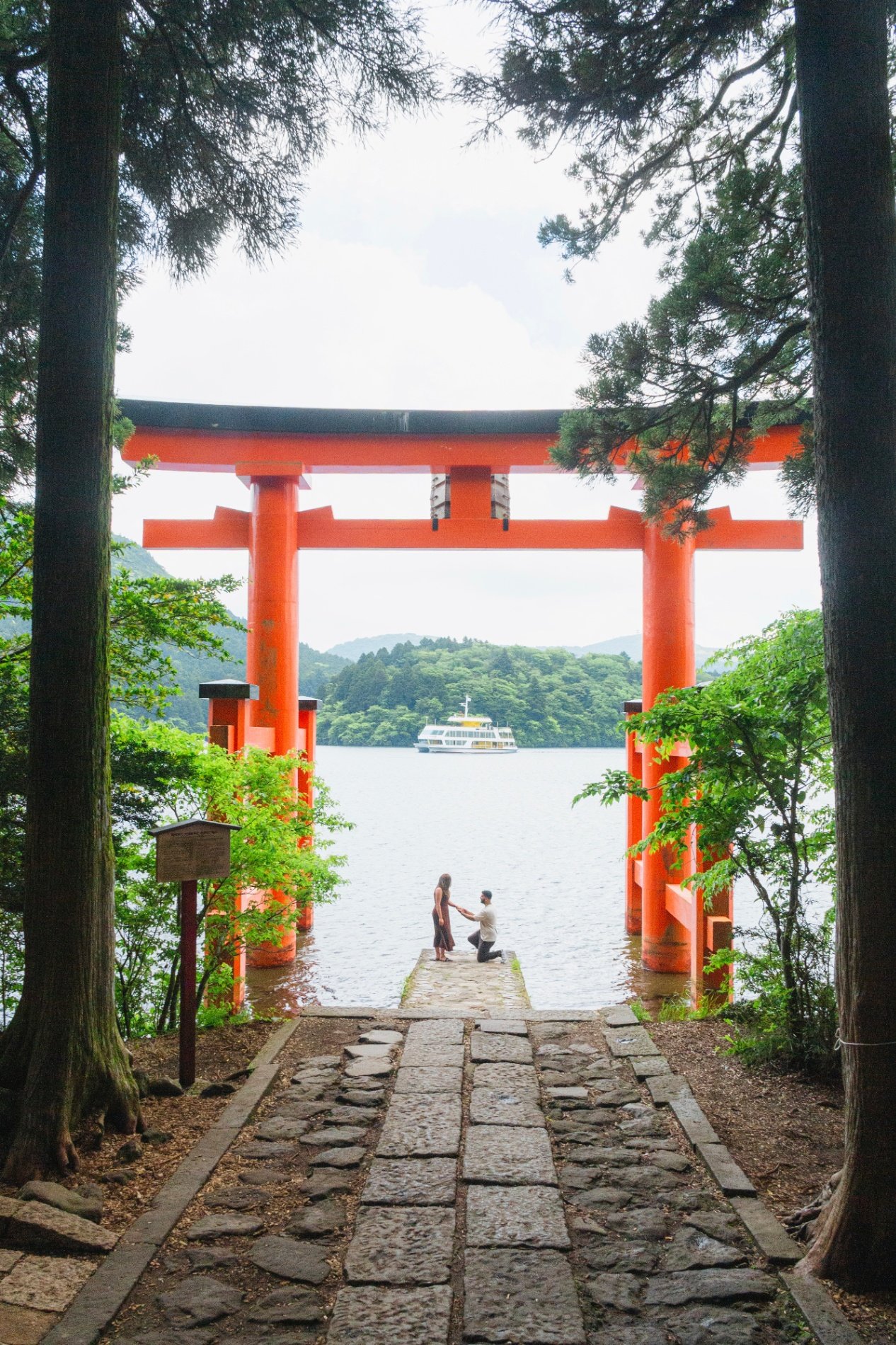
Proposing with Mount Fuji: Hakone's lake gate, Lake Kawaguchi and Chureito Pagoda
A proposal that depends on a mountain needs a plan B, and the time to write it is before you leave home. Mount Fuji is not a backdrop you can book: it stands clear on most winter mornings and hides for whole weeks of summer, it often shows at first light and is gone behind its own cloud by mid-morning, and the night before no forecast will give you more than a probability. Three places below put the question in front of the mountain. Each costs something in privacy, and each has a version that is still worth having if Fuji never appears.
Real shots from Hakone
The odds, plainly
November to February is the season. Cold, dry air comes down from the north-west, the summit carries snow, and the clearest hours of the year are the ones around sunrise. As the valley warms, cloud builds on the flanks; by nine or ten the mountain is often capped and what you saw at six is gone. Summer is the opposite: heat and humidity haze over the whole Kanto plain, and Fuji can be invisible for a fortnight at a time in July and August. The rainy season from early June to mid-July and the typhoon months after it do not help either.
So the first decision is the month and the second is the hour. At the lakes the sun comes up a little before seven in January and closer to half past six in late November. In winter that rules out the first train from Tokyo — you cannot leave the city at six and be in position for a sunrise that has already happened. Plan to sleep nearby.
Two mornings are better than one. Tourist offices and hotels around the mountain run live cameras pointed at it, and that is the only honest forecast there is: look one up the night before and again when you wake, and search for a current one rather than a link saved a year ago.
Hakone: the torii standing in the lake
Heiwa no Torii, the vermilion gate below Hakone Shrine, stands in the shallows of Lake Ashi at the Motohakone end, with cedars behind it and the water in front. It is the most photographed object in Hakone, and it is managed accordingly: at busy times the shrine runs a staffed queue for the short stone platform in front of the gate, with a posted limit of a couple of minutes per group. Those arrangements have tightened more than once — check what is in force before you build a morning around them.
Which means a proposal at the torii comes with an audience and a clock. For some couples that is exactly the point: strangers clapping, the red gate, the lake behind. For others it is the worst version of the day.
Fuji shows from the Motohakone shore up the lake to the north-west on a clear morning, but mountain and gate in one frame is a narrow angle usually taken from the water. Treat them as two pictures, and put the question wherever you are calmest — the cedar stair climbing from the lake to the shrine, lanterns and moss on both sides, is quieter than the gate at any hour.
Getting there from the city takes about two hours: the Odakyu Romancecar from Shinjuku to Hakone-Yumoto in roughly eighty-five minutes, then a Hakone Tozan bus of about forty minutes to Motohakone-ko, and five minutes along the shore. First light on Lake Ashi usually comes with mist lifting off the water, which is the best thing the place does.
Lake Kawaguchi's north shore: room to be alone
The north shore of Lake Kawaguchi looks straight across the water at the mountain, and that is why every postcard comes from this side. Oishi Park sits at the western end with flower beds along the promenade; the promontory around Ubuyagasaki, further east, is the classic spot for the reflection. That reflection — sakasa-Fuji, the upside-down mountain — needs a surface with no wind on it at all, which in practice means the first two hours after light, before the valley breeze gets up. The sun rises to your left and rakes across the mountain's face while the shore stays soft.
The difference from Hakone is space. The path along the north shore runs for kilometres; fifty metres from a car park you have it to yourselves, and in February at dawn you may have the whole bay. No queue, no clock, nobody watching but the person holding the camera.
Trains run from Shinjuku on the JR Chuo line to Otsuki and then the Fujikyuko line to Kawaguchiko, and the highway buses take around two hours; the sightseeing buses that circle the lake reach Oishi Park in about half an hour but start far too late for a winter sunrise. Book a taxi the night before or take a room on the north shore itself.
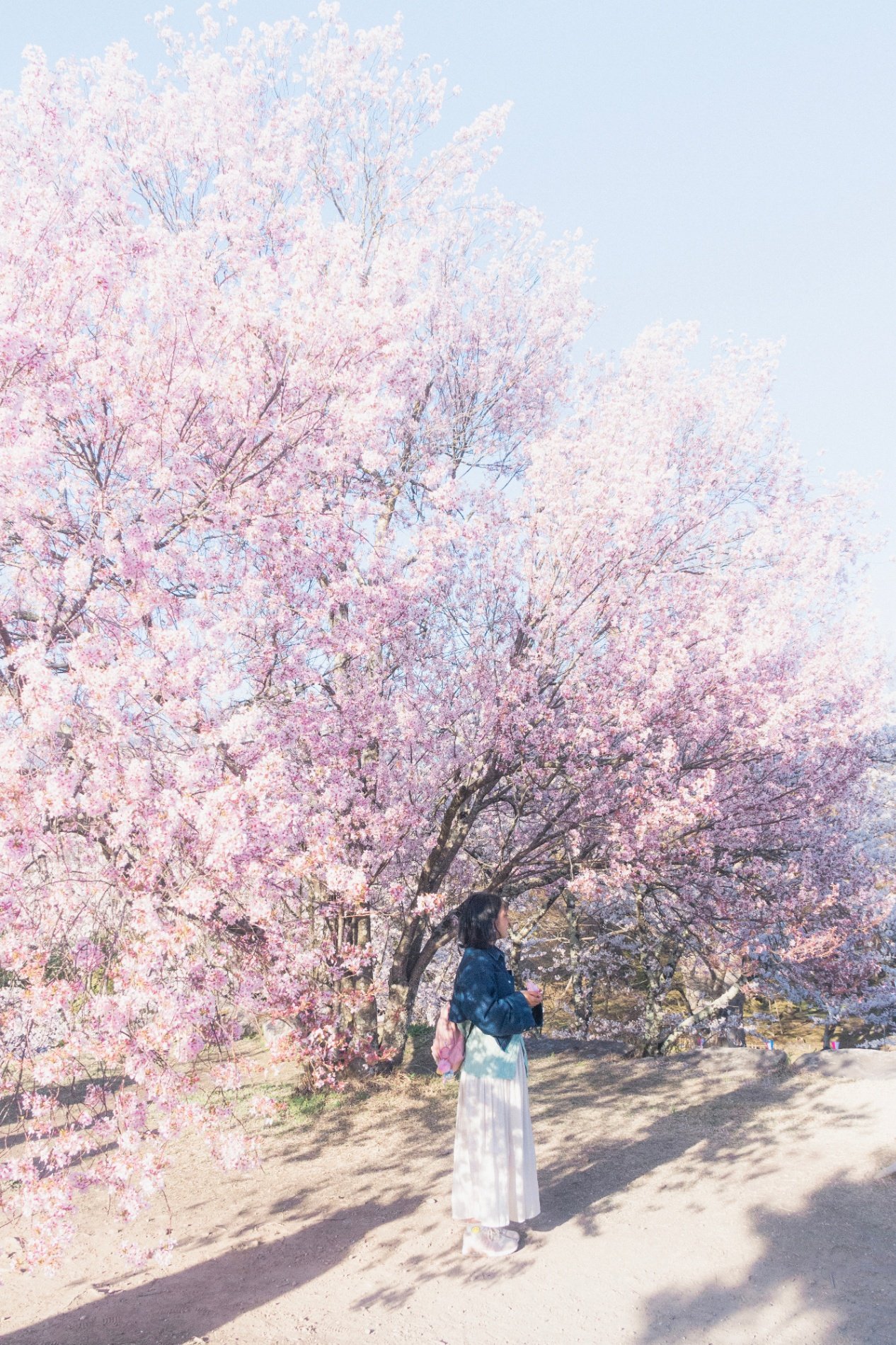
Two seasons change the picture. Blossom at the lakes runs roughly a fortnight behind Tokyo — mid-April rather than late March, in scattered trees rather than an avenue. Autumn colour comes late October into mid-November, when the maple corridor near the eastern end of the lake is lit in the evenings; those dates move every year, so check them.
Chureito Pagoda: the public version of the picture
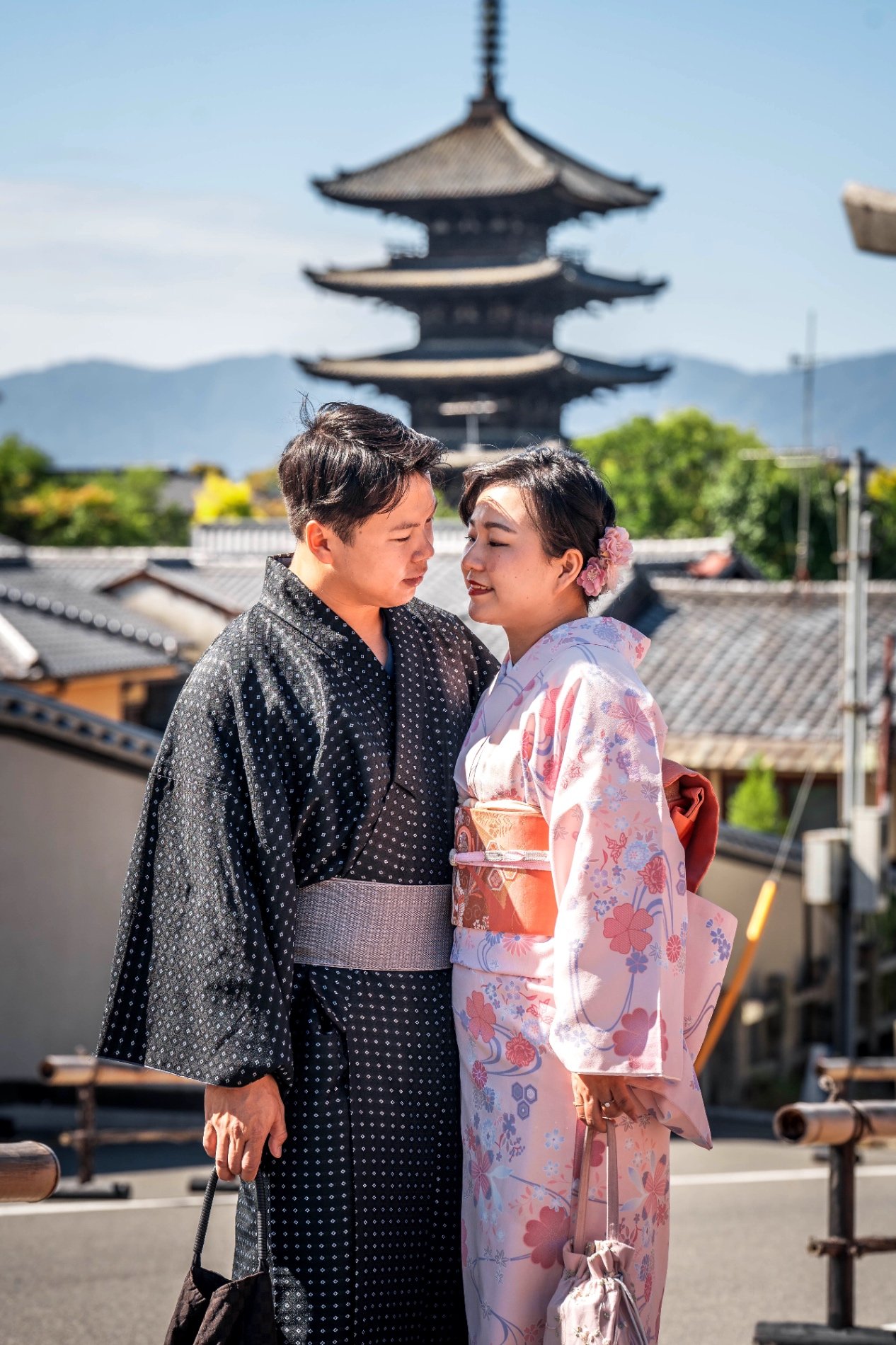
The five-storey pagoda in Arakurayama Sengen Park above Fujiyoshida gives the frame everyone knows: pagoda, town, mountain, stacked in three planes. It costs 398 stone steps from the shrine below. A zig-zag slope runs alongside part of the way for anyone who would rather not take all of them, though the last stretch is steps again, and there is no way up without climbing. From Shimo-Yoshida station on the Fujikyuko line it is about ten minutes on foot to the park entrance and roughly half an hour in total to the platform.
The viewing deck faces west, so at sunrise the light arrives from behind you and the snow on the summit turns pink for a few minutes before the day goes flat. It is also small: in blossom week and on clear autumn weekends there are tripods three deep on it an hour before the sun, and a proposal there is a public event whether you meant it to be or not. A weekday in December or January is a different place.
What clients say about this kind of shoot
We had such a great photography experience with OKINI PHOTO TOUR! If you’re looking for an Osaka photographer, especially for a couple photoshoot in Osaka, I would definitely recommend them. The photographer made us feel comfortable from the beginning and guided us naturally with poses, so even if you’re not used to being in front of a camera, the experience is very relaxed and fun. What I really liked was that this wasn’t just a typical photoshoot. We walked around Osaka and enjoyed the city while taking photos, so it felt like both a photo tour and a local Osaka experience. The photos around Dotonbori and Osaka’s neon streets were especially beautiful. The photographer knew where to shoot, how to use the city lights, and how to capture natural moments between us. For couples traveling in Japan, honeymooners, or anyone searching for couple photography in Osaka, an Osaka travel photographer, or a Dotonbori photoshoot, OKINI PHOTO TOUR is a great choice. A wonderful way to keep memories from our trip to Osaka. Highly recommended!
— 伊藤尚也 on Soh
Amazing service and perfect photos! Highly recommended—thank you.
— Inbar B. on Ryoji M.
Amazing service. I booked for an engagement photoshoot, and even though he had other commitments made himself available. Was extremely helpful in choosing locations and keeping in contact before with weather updates! Do not hesitate to book if considering a photographer in the area
— Ben F. on Ryoji M.
Soh was the best! He knew all the hidden gems in Tokyo and we had the best shoot with him! Super professional, on time and gave great creative direction!
— Cathy D. on Soh
Soh was INCREDIBLE! The shots he got for us were so awesome, he knew so many amazing off the beaten path spots for pictures. 10/10 if you want awesome photoshoots come here!!
— Yeremi H. on Soh
I had such a great photoshoot experience with Okini! 📸✨ It was honestly so much fun, and the photos turned out absolutely beautiful. The Tokyo Tower spots were perfect, and our 2-hour photoshoot gave us so many amazing shots. Everything felt fun, relaxed, and worth it from start to finish. Definitely such a memorable experience and one I’d recommend if you want beautiful photos in Tokyo! 🗼💕
— Maria D. on Soh
Which one suits which couple
If the moment should be shared — if you like the idea of strangers working out what is happening and cheering — take the torii at Hakone, accept the queue, and let the audience be part of the story. If it should be private, take the north shore of Lake Kawaguchi and let the photographer work from a distance. If what you want above all is the photograph everyone recognises, climb to Chureito Pagoda and treat the audience as scenery.
There is also what the two of you can physically do at dawn in winter. The lakeshore is flat and a hundred metres from a road. The pagoda is four hundred steps in the dark, in cold that bites, with a stranger's tripod at your elbow. Neither is better; they are different mornings.
Dawn, in near-freezing air
Cold is the practical enemy: hands stop working, and a ring is small. Keep it in an inside pocket rather than a coat pocket, in a closed hand rather than a box when the moment comes, and do not open anything over a wooden deck, a stone platform or fresh snow — things fall through gaps and are not found again. Thin liners under proper gloves keep your hands covered until the last second, and layers you can strip off in twenty seconds make the pictures look like a spring morning at minus four.
Hiding a photographer here is easier than anywhere else in Japan: somebody with a camera and a tripod pointed at Fuji at sunrise is the most ordinary sight on these shores. Agree the signal, the spot and the direction you will walk before you separate, and give the photographer a line that does not cross anyone else's tripod. Then take twenty unphotographed minutes before the phone calls start.
If the mountain never appears
Sooner or later it is a morning with no mountain in it, and the honest advice is to ask anyway. The photographs of a proposal are of two faces; the mountain is behind them. Mist on a still lake, frost on the reeds, boats at the Motohakone jetty, the cedar stair at the shrine, the pagoda framed by blossom, the maple corridor in November — all of that is there whether or not Fuji is. If the trip has a spare morning, keep it for a second attempt and plan the first as though it counts.
Planning a proposal photoshoot at Mount Fuji
Start before sunrise, in winter if you have the choice, and build the session around one place rather than three. Sixty minutes covers the moment and the portraits that follow it; ninety gives you the walk, the shore or the steps, and the light changing while you are still up there. Hakone and the Fuji lakes are two different days, not two stops on one, and both begin the evening before, usually from Tokyo.
Tell the photographer everything in advance: where you will stand, how you will arrive, what the signal is. Somebody who works these shores in winter knows which lay-by is clear of cars at six, which part of the north shore holds the reflection longest, and when to stop shooting and step back.
You can read what a proposal photoshoot usually covers and book a photographer online.
Want professional photos in Hakone?
Browse portfolios, compare packages, and book a verified local photographer in minutes.