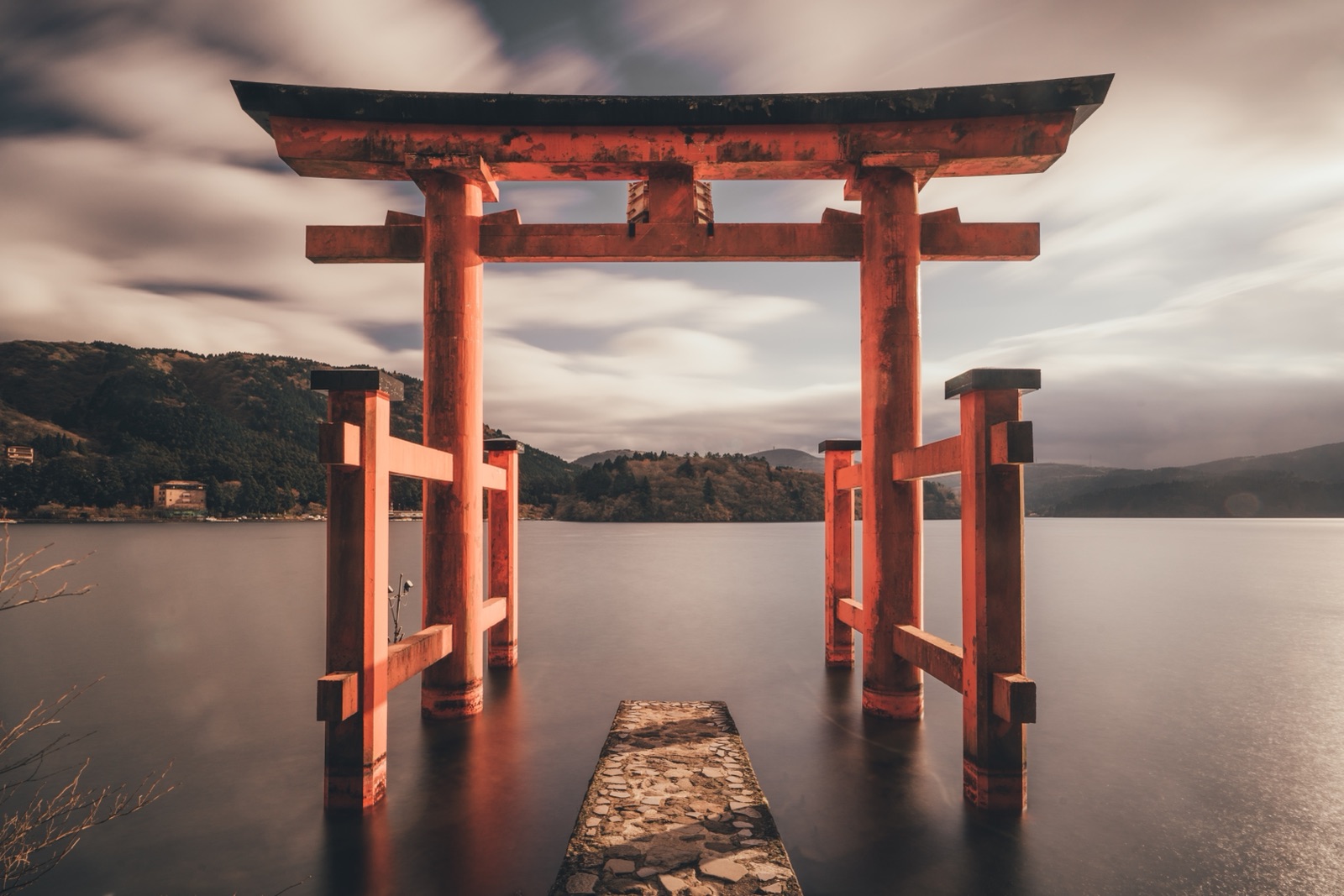
Hakone Photoshoot Guide: the torii on Lake Ashi and Fuji on a clear morning
Most people come to Hakone for one photograph: the red torii of Hakone Shrine standing in the shallows of Lake Ashi, with the mountain behind it. Two things decide whether you get it, and neither is your camera. The first is the queue — there is a marked line in front of the gate, and by mid-morning at a weekend it can take the best part of an hour to reach the front. The second is weather nobody controls: Fuji is a matter of odds rather than hours, good on cold clear winter mornings and close to hopeless in summer haze. So build the session around the gate at first light, treat the mountain as a bonus, and spend the rest of the day in a caldera that photographs well whether or not the sky cooperates.
The torii in the lake, and the line in front of it
The gate is the Heiwa no Torii, the torii of peace, and it is a modern addition to a shrine that has stood in these cedars far longer. It sits in the water at Moto-Hakone, at the southern end of the lake, with a short wooden deck beside it where everyone stands. The shore faces roughly northwest, so early sun comes over your shoulder and lights the front of the gate while the lake is still flat; the same frame in late afternoon is backlit and dull.
Arrive before eight and the wait is a few minutes. Arrive at eleven on a Saturday in November and the line runs back along the path. Shrine staff manage it, each group gets a short turn on the deck, and how long that turn is — and where a camera may go — is the shrine's decision. The arrangement has changed more than once and can change again, so check the shrine's current rules before you plan a session around the spot. An arranged shoot on shrine ground is a separate question from a visitor taking pictures, and the answer belongs to the shrine.
Two frames most people miss. The first is the approach to the shrine itself: a stone staircase climbing through cedars with stone lanterns down both sides, dim, green and nearly empty while the line at the gate is an hour long, and better in flat light than in sun. Walk up the side of the path rather than down the middle; the centre is for the deity, not for the photograph. The second is the gate from further along the lakeside path, small in a wide frame with the water and the far hills — the version that survives a crowded deck.
Whether the mountain turns up
From Moto-Hakone, Fuji sits beyond the northern end of the lake, so the frame that has both gate and mountain in it needs that particular distance to be clear. A bright morning on the shore means nothing if the north end is under cloud. The pattern is consistent enough to plan against: cold, dry mornings from November to February give the best chance, the mountain is most often out in the first hours after sunrise, and cloud builds around it as the valley warms through the day. From June the air thickens, and July and August can hide Fuji for a fortnight at a time.
The honest advice is to book the session for the gate, the cedars and the lake, and to let the mountain either appear or not. If Fuji is the whole reason for the trip, the lakes on its northern side give a bigger, closer version of it — that is Lake Kawaguchi — while Hakone gives you the gate, which they do not.
The cedar avenue and the park nobody visits
Between Moto-Hakone and Hakone-machi, a five-hundred-metre stretch of the old Tokaido highway runs under cedars planted some four hundred years ago to shelter travellers walking between Edo and Kyoto. Several hundred trees make a tunnel that direct sun never reaches the floor of, which makes it one of the few places here that works at midday and in rain. It is flat, a few minutes from the shrine, and usually quiet.
At the end of it, Onshi Hakone Park occupies a wooded peninsula pushing into the lake — the grounds of a former imperial villa, open and free, and badly under-visited: lawns, gravel paths and a terrace looking back up the water. On the morning the queue at the gate is impossible, this is where the session goes instead. The reconstructed checkpoint buildings at Hakone-machi are ticketed and keep their own seasonal hours.
Up the caldera: the Tozan railway, Gora and the ropeway
The small red trains of the Hakone Tozan line climb from Hakone-Yumoto to Gora in about forty minutes, reversing at three switchbacks where driver and guard change ends while you sit still. From the middle of June hydrangeas line the track, starting near the bottom and finishing weeks later up near Sounzan as the bloom climbs with the altitude; there are evening illuminations and reserved evening services in that window which go early — check the dates and how tickets are sold rather than assuming.
Above Gora a funicular runs up to Sounzan, and the ropeway crosses the sulphur field at Owakudani, steam coming out of yellow ground with Fuji behind it on a clear day. Treat this as the least reliable part of any plan. The ropeway stops for strong wind and for volcanic gas, sections close for inspection in the winter months, and a rise in the volcanic alert level restricts the area. Check the operator's status on the morning; a substitute bus usually runs when a section is down. Do not make the ropeway the one frame a session depends on.
What clients say about this kind of shoot
We had such a great photography experience with OKINI PHOTO TOUR! If you’re looking for an Osaka photographer, especially for a couple photoshoot in Osaka, I would definitely recommend them. The photographer made us feel comfortable from the beginning and guided us naturally with poses, so even if you’re not used to being in front of a camera, the experience is very relaxed and fun. What I really liked was that this wasn’t just a typical photoshoot. We walked around Osaka and enjoyed the city while taking photos, so it felt like both a photo tour and a local Osaka experience. The photos around Dotonbori and Osaka’s neon streets were especially beautiful. The photographer knew where to shoot, how to use the city lights, and how to capture natural moments between us. For couples traveling in Japan, honeymooners, or anyone searching for couple photography in Osaka, an Osaka travel photographer, or a Dotonbori photoshoot, OKINI PHOTO TOUR is a great choice. A wonderful way to keep memories from our trip to Osaka. Highly recommended!
— 伊藤尚也 on Soh
Amazing service and perfect photos! Highly recommended—thank you.
— Inbar B. on Ryoji M.
Amazing service. I booked for an engagement photoshoot, and even though he had other commitments made himself available. Was extremely helpful in choosing locations and keeping in contact before with weather updates! Do not hesitate to book if considering a photographer in the area
— Ben F. on Ryoji M.
Soh was the best! He knew all the hidden gems in Tokyo and we had the best shoot with him! Super professional, on time and gave great creative direction!
— Cathy D. on Soh
Soh was INCREDIBLE! The shots he got for us were so awesome, he knew so many amazing off the beaten path spots for pictures. 10/10 if you want awesome photoshoots come here!!
— Yeremi H. on Soh
I had such a great photoshoot experience with Okini! 📸✨ It was honestly so much fun, and the photos turned out absolutely beautiful. The Tokyo Tower spots were perfect, and our 2-hour photoshoot gave us so many amazing shots. Everything felt fun, relaxed, and worth it from start to finish. Definitely such a memorable experience and one I’d recommend if you want beautiful photos in Tokyo! 🗼💕
— Maria D. on Soh
Gora, the sculpture museum and the wet-weather plan
The Hakone Open-Air Museum, at Chokoku-no-Mori on the Tozan line, sets sculpture on open lawns with mountains behind and has a stained-glass tower with a spiral stair inside it — a strong graphic backdrop in the flattest weather. Personal photography is ordinary there; a session with a booked photographer is a different thing, and museums and private gardens decide that for themselves. Ask in writing before the day.
Rain is not the disaster here that it is elsewhere: wet cedar is darker and better, and mist on the lake removes the far shore for you. Keep the ropeway for the clear day and shoot the low ground on the wet one.
Ryokan gardens, private onsen and what may be photographed
A ryokan night is why Hakone suits a honeymoon: you are at the lake before the day buses arrive and still there after they leave. It comes with rules worth knowing before anyone unpacks a camera. Public baths are never photographed, full stop. A private open-air bath attached to a room is the one place where a bathing frame is even a question, and the answer belongs to the house — ask when you book. Gardens, corridors and lobbies usually need a word at the front desk first; most houses say yes when asked in advance and no when surprised. Tattoo policies differ from house to house, some accept cover patches and some do not, and that is also a booking-time question rather than an arrival-time one.
The yukata a ryokan provides photographs well indoors and on a garden veranda. It is worn left over right, as any kimono is, and it is not a costume.
What each season changes
Autumn colour reaches lake level in the second half of November, and the higher ground above Gora and Sounzan turns a couple of weeks earlier — if you have missed it below, go up. Winter is the season for the gate: the clearest Fuji mornings of the year, the quietest lake, and a cold at dawn on the water that nobody looks relaxed in for two hours, so plan a shorter session and somewhere warm at the end of it. Blossom arrives later here than in Tokyo, usually into April, and Golden Week at the end of that month is the worst week of the year to attempt Hakone: this is Tokyo's weekend valley and the whole city comes. Any weekday beats any weekend.
Planning a Hakone photoshoot
Start at the gate, early, and let the rest follow. Sixty minutes covers the torii and the shore if you are there before the line forms. Two hours adds the shrine staircase and the cedar avenue, or the park and the lakeside path, with a short walk between them. Do not try to combine the lake and the ropeway in one session — they are separated by a bus ride over the caldera rim, and one of them may be shut that day.
Hakone is about ninety minutes from Shinjuku on the Odakyu Romancecar to Hakone-Yumoto, then the mountain railway or a bus onwards. Whether a regional pass earns its keep depends on how much of the loop you use, so do that arithmetic for your own route. The first train out of Tokyo does not reach Moto-Hakone before the queue does, which is the practical argument for staying the night.
A photographer who works here regularly knows which morning the lake goes flat, which end of the deck the staff will let you use, and where the session goes when the ropeway is down — that knowledge is most of what you are booking. The destination page for Hakone covers the rest of the area, honeymoon sessions explain what a session usually includes, and you can book a photographer online.
Want professional photos in Hakone?
Browse portfolios, compare packages, and book a verified local photographer in minutes.