Family Snow Photoshoot in Hokkaido: Sapporo, Otaru and the ski-town weeks
Hokkaido is the one part of Japan where you can plan a snow photoshoot months ahead and expect snow. From December to March Sapporo has it on the ground rather than in the forecast, which turns the whole city into a soft white studio with light bouncing up into faces from below. What the north does not give you is time. Children last about twenty minutes outdoors when it is ten below, daylight runs out a little after four in January, and the two weeks in February that everybody photographs are the two weeks everybody books. Plan around those three facts and the rest is straightforward.
Sapporo from December: where the snow actually sits
Sapporo is a grid city built for this. Snow is cleared off the roads and left everywhere else. Odori Park is the obvious frame: a dozen blocks of park running east to west through the middle of the city, with the TV tower closing the view at one end and banks of snow along every path. It works in the morning for clean white light and again after dark, when the tower and the surrounding buildings light the snow for you.
Nakajima Park, south of the centre, is the quieter version — a frozen pond, bridges, big trees, and space enough that your family is not in somebody else's photograph. Moerenuma Park, out to the north-east, is geometry under snow and an obvious sledging hill, on reduced winter operation, so check what is open first.
Hokkaido Jingu under snow
The approach to Hokkaido Jingu is the best fifteen minutes of walking in the city in winter. The shrine stands inside Maruyama Park, the path runs under tall trees with snow on every branch, and the torii, the lanterns and the wooden buildings all come up dark against white. Take the Tozai subway line to Maruyama-Koen and walk in, roughly fifteen minutes on a cleared path.
It is a working shrine, so the ordinary rules apply: walk to the side of the path under a torii rather than down the middle, do not photograph inside the halls, and assume an arranged shoot on shrine ground needs the shrine's own permission, asked for well before the day. The New Year days at the start of January are the busiest of the shrine's year, with queues down the whole approach — remarkable to see, and a poor morning to photograph a family.
The February fortnight everybody wants
In early February Odori Park fills with snow and ice sculptures for about a week, with a second site of ice carvings in the Susukino entertainment district and a family site with slides and snow play further out. In the same fortnight Otaru lines its canal and side streets with candles and snow lanterns for its own evening festival.
It is the most photogenic week of the Hokkaido winter and the hardest to move around in. Odori is shoulder to shoulder from mid-morning until late, hotels in both towns sell out months ahead, and photographers' evening slots go with them. If those are the pictures you want, book the trip and the session together and do it early. If they are not, the last week of January or the first week of March gives you the same snow with the city to yourselves. Both festivals set their dates year by year, so check before you book around them.
Otaru: the canal, the gas lamps, half an hour on the train
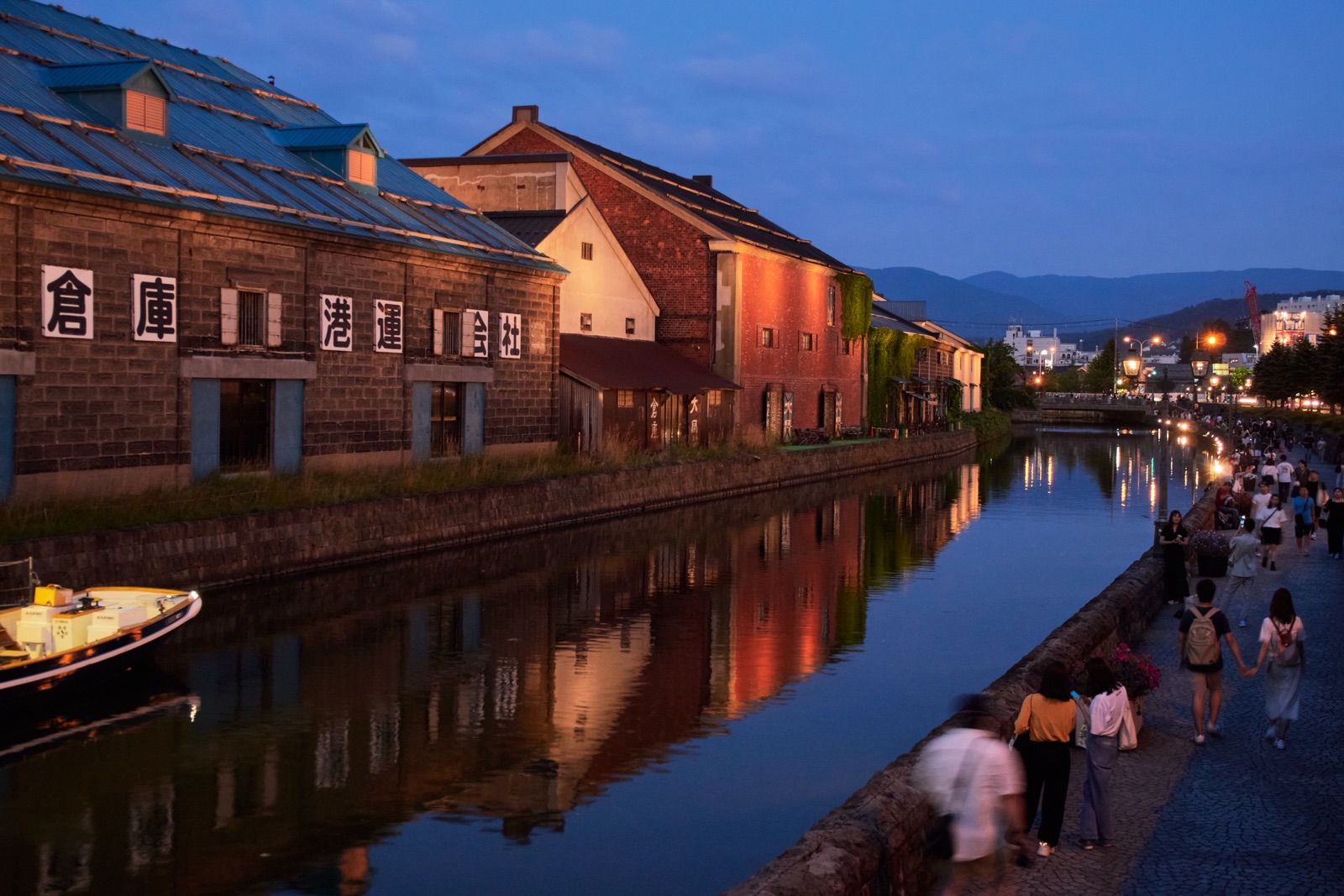
Otaru is a little over half an hour west of Sapporo on the JR rapid service, and it is the easiest good decision in this itinerary. The canal runs for about a kilometre past stone warehouses, and the gas lamps along the promenade come on around dusk and throw their light back off the water. In winter there is snow on the stone, snow on the warehouse roofs, and warm light at the exact hour the family is starting to get cold.
Aim for the half hour before and the half hour after the lamps come on. The canal path is level and short, the station is about ten minutes' walk away, and the shopping street between them is lined with glass workshops and music-box shops — which is to say there is somewhere warm every fifty metres, and with a five-year-old in the party that matters more than any view.
Ski towns and the hour between lessons
If the trip is built around skiing, the session goes in the gap between lessons rather than instead of them. Sapporo has ski areas inside the city limits: Bankei is a short bus ride from the subway on the western side, Teine a train and a bus to the north-west, and both have beginner slopes and a fenced snow-play area with sledges and tubes. That is the frame — children in helmets at the foot of a slope, snow in the air, a chairlift behind them.
Three points decide whether it works. Slopes are private ground, so a resort's permission for an arranged shoot is its own decision and you ask first. Lift seasons open and close with the snow and vary from year to year, so check current operating dates rather than last winter's. And a beginner slope at the bottom photographs better than the summit, because the summit is usually in cloud and always in wind.
Why snow makes a family look grey
A camera left to its own judgement reads all that white as mid-grey and darkens the whole frame: faces come out muddy and the snow looks like dishwater. The fix is to overexpose deliberately, and any photographer who works in Hokkaido does it without thinking. If you are shooting the rest of the trip on a phone, tap the face and drag the exposure up.
What you wear matters more here than anywhere else. White and pale grey jackets disappear into the background and leave four floating heads. Strong flat colour is what works: red, mustard, deep green, navy, burnt orange. Put the children in the brightest colours and keep the adults a shade quieter, and avoid head-to-toe black, which collapses into a silhouette against snow. Hats and mittens are the accessories that make the picture; goggles pushed up on a forehead look great and sunglasses do not.
Twenty minutes is a long time at minus ten
Sapporo in January stays below freezing all day and goes well under it at night, and a child who is cold is finished. Build the session as short bursts with warmth between them: fifteen or twenty minutes outside, then a café, then another fifteen. A city session on Odori or along the Otaru canal is perfect for this because there is always a door nearby. A shrine approach or a park is not, so do that part first, while everyone is fresh.
The kit list is short and it decides everything. Proper snow boots with a grip sole, because the pavements are polished ice by February and everybody goes over at least once. Two pairs of gloves per child, because the first pair is wet after the first snowball. Hand warmers in pockets. A hat that covers ears. Leave the umbrella: it snows here, it does not rain.
Four o'clock is the family hour
Hokkaido's winter days are short. In early January the sun is up around seven and gone a little after four, and the blue hour that follows is unusually long and unusually clean, with city light and snow doing most of the work. That is convenient rather than limiting: late afternoon is exactly when small children are at their best, and a session that starts at half past two and ends with the lights coming on covers daylight, dusk and lamplight in one go. Bright overcast in the middle of the day is the other gift — nobody squints, there are no hard shadows, and every face is lit from all sides. Do not be disappointed by a grey sky here; be disappointed by a low sun at noon.
Already on the main island? Takayama and Shirakawa-go
If Hokkaido does not fit the trip, the snow country in the Japan Alps does much the same job for families based around Tokyo, Kyoto or Nagoya. Takayama's old merchant streets take snow beautifully and are flat and short, which is the whole argument with small children, and the thatched farmhouses of Shirakawa-go under a metre of snow are the postcard of Japanese winter. The bus over from Takayama takes about an hour. Winter services and the village's evening light-up run on limited dates with reservations and change from year to year, so check the current arrangements well ahead.
Planning a family snow photoshoot in Hokkaido
December to March is the window, and February is the deepest, the prettiest and the most crowded. Sixty minutes is the right length for a family session in the cold: long enough for two locations within a short walk, short enough that nobody is miserable. Ninety works if half of it is indoors. Book earlier than you would anywhere else, and if your dates are flexible ask for late January or early March.
Tell the photographer how old the children are and how much cold they will tolerate, and let them build the route around warm stops rather than around views. You can read the destination page for Sapporo, see what a family photoshoot usually covers and how booking works, and find a photographer online. For families staying on the main island, Takayama is the winter alternative.
Want professional photos in Sapporo?
Browse portfolios, compare packages, and book a verified local photographer in minutes.